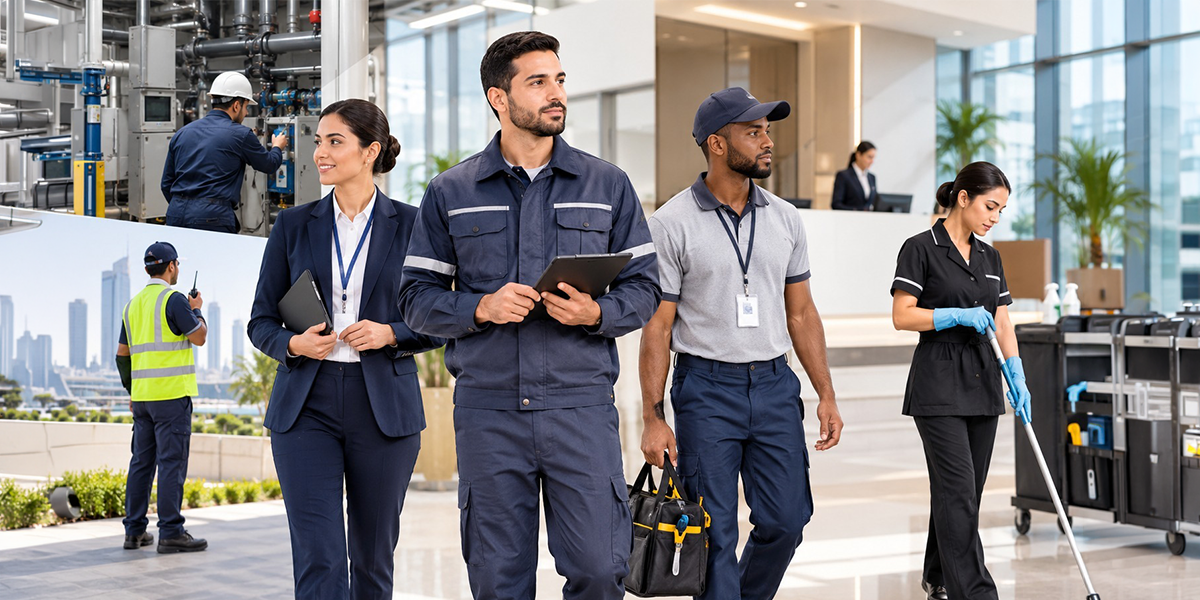
Facility management uniform planning should begin with the daily operation of a building rather than with a standard clothing template. Facility teams can move between plant rooms, service corridors, reception areas, loading zones and external spaces during the same shift. Each environment can create different demands for mobility, storage, comfort and presentation, making operational requirements more important than simply giving every employee identical clothing.
Facility management also involves both planned and unexpected work. A technician may begin with a scheduled inspection before responding to an urgent maintenance request, while another employee may spend the day moving between occupied areas and technical spaces. In Dubai, employees may additionally move between heavily air-conditioned interiors and warmer external or semi-enclosed areas. These changing conditions make workwear planning a practical part of daily building operations.
Understanding the Working Environment Before Selecting Garments
A facility operation is made up of connected activities rather than one type of task. Maintenance, inspections, equipment checks, cleaning coordination, minor repairs and tenant support can all require employees to move through different parts of a property. Garments therefore need to accommodate the actual work journey instead of being selected solely according to an employee’s job title.
For example, a technician working around building services may need easy movement and practical storage when accessing equipment. An employee conducting inspections may spend more time walking through occupied spaces and interacting with building users. These responsibilities may sit within the same facilities team, but the clothing requirements are not necessarily identical.
Map the building zones and daily activities
Before finalising garment specifications, managers can identify the areas each team enters and the activities performed there. This provides a more useful basis for workwear decisions than selecting one garment for everyone.
- Plant rooms may require practical garments that support movement around equipment.
- Public areas may require a neat appearance during tenant interaction.
- Service and loading areas may create greater visibility requirements.
- Outdoor duties may require attention to ventilation and changing conditions.
This approach helps managers identify which features are genuinely necessary. It can also prevent unnecessary variations by showing where the same garment can work effectively across several areas.
Facility Management Uniform Requirements During Reactive Maintenance
Reactive maintenance creates a different working pattern from scheduled inspections. When an urgent service request is received, an employee may need to leave one area immediately, travel through occupied spaces and reach a technical location without time to prepare for a different working environment. The clothing needs to remain practical throughout that transition.
Storage can also become important during service calls. Employees may carry access cards, small tools, inspection equipment or other essentials while moving between floors or buildings. Well-positioned pockets can reduce unnecessary trips to a workshop or storage room, provided they do not add excessive bulk or restrict movement.
This is where corporate workwear needs to be considered alongside operational requirements. A professional appearance remains useful when employees interact with occupants, but presentation should not compromise movement or functionality. The garment needs to support the employee’s actual responsibilities rather than simply resemble conventional office clothing.
Consider the complete service journey
The location where an employee finishes a task may be very different from where the task begins. A technician could start at a facilities office, pass through reception, use a service lift and then spend considerable time inside a plant room.
- Garments should remain comfortable during frequent walking.
- Essential items should remain accessible during technical work.
- Identification should remain visible when employees enter occupied areas.
- Clothing should not create unnecessary restrictions around equipment.
Considering the complete route gives managers a better understanding of how clothing performs during real service calls. It also makes the workwear more suitable for employees whose duties change several times during a shift.
Matching Garments to Different Facility Operations
Facility teams can include technical maintenance staff, inspection personnel, property support employees and other operational workers. Their responsibilities may overlap, but the physical demands of their work can vary considerably.
A technician who regularly accesses equipment may need greater freedom of movement and practical storage. An inspection-focused employee may spend more time walking through public areas. Someone responding to tenant requests may need to combine operational practicality with a consistently presentable appearance.
Employee uniforms can therefore be organised around a common framework rather than one completely identical garment. A core range can establish consistency, while selected garments can be adapted when a particular responsibility creates a genuine operational requirement.
Assess each team’s working pattern
Before introducing different garments, managers should examine how each team actually spends its working day. Useful questions include:
- How much time does the team spend moving between locations?
- Does the team regularly enter technical or restricted areas?
- Are employees frequently responding to unplanned service requests?
- How often do they interact directly with occupants or visitors?
The answers can reveal whether a variation is genuinely necessary. This prevents uniform programmes from becoming unnecessarily complicated while still allowing workwear to reflect real differences between teams.
Managing Public and Technical Areas Within One Operation
Facility employees often move between spaces with very different expectations. A person carrying out an inspection may speak with a tenant in a reception area before entering a service corridor or equipment room. A garment designed only around technical work may not provide the same suitability when the employee returns to a public environment.
A practical approach is to establish company uniforms around a shared visual framework while allowing limited functional differences. Common colours, approved garment styles and consistent identification can connect teams without forcing every employee to wear exactly the same combination.
This is particularly useful where a facilities provider manages several buildings. One property may have extensive outdoor areas, while another may consist largely of enclosed commercial spaces. A common framework allows the organisation to maintain consistency while recognising genuine differences in daily operations.
Design for movement between zones
The uniform should remain practical as employees move through different areas during normal service activity.
- Reception-to-service-room movement requires a balance of presentation and functionality.
- Indoor-to-outdoor movement may make ventilation and fabric weight important.
- Public-to-restricted-area movement can make clear identification useful.
- Multi-floor assignments can increase the importance of mobility and storage.
These considerations make workwear part of operational planning rather than a separate branding exercise. They also give managers clearer reasons for selecting particular garment features.
Managing Workwear Across Multiple Properties
Facilities companies may operate properties with different layouts, tenant requirements and maintenance arrangements. One building may involve extensive plant and external service areas, while another may require employees to spend most of their time in occupied indoor spaces.
For organisations using branded uniforms, consistency can be maintained through approved colours, garment styles and identification standards. However, branding should support operational requirements rather than dictate every garment decision. A technical employee should not be given impractical clothing simply because it matches a customer-facing design.
Stock management is another consideration. Employees can transfer between properties, join new teams or require replacement garments at different times. Keeping the approved garment range controlled can make ordering and allocation easier across multiple locations.
Plan for replacement and staff movement
A uniform programme should account for what happens after the initial order. Garments experience different levels of wear depending on the employee’s duties, while new starters and transfers can create additional demand.
- Record approved garments for each operational role.
- Maintain current sizing information for teams and locations.
- Identify garments that require more frequent replacement.
- Keep commonly issued items available for new starters.
This approach reduces the risk of individual properties gradually adopting unrelated clothing styles. It also gives managers a practical system for maintaining consistency as operational teams change.
Considering Climate and Building Conditions
Building design can influence workwear requirements just as much as the task itself. Employees working inside highly conditioned properties may experience different conditions from those who regularly inspect external equipment, loading areas or service zones.
In Dubai facilities, this transition can be especially relevant where employees move between cooled interiors and warmer outdoor areas. The same employee may experience several environmental changes during a single shift, making garment weight, breathability and ease of movement important considerations.
A personalised work uniform can include approved identification details where these genuinely help employees remain recognisable. However, personalisation should not take priority over garment performance. Names or role details should be positioned carefully so that they remain useful without interfering with pockets, fastenings or other functional elements.
Similarly, a work uniform with company logo can help occupants identify authorised facility personnel. Logo placement should remain practical and should not determine the position of essential garment features.
Creating a Practical Workwear Framework
When sourcing from uniform manufacturers in Dubai, managers can discuss fabric, garment features, sizing and production requirements based on the actual duties performed by each team.
For facilities teams working across properties, this approach can help accommodate differences between commercial, residential and mixed-use buildings. It also makes the programme easier to manage because every garment variation has a clear operational purpose.
The framework should be reviewed when building operations change. New equipment, altered service arrangements, additional responsibilities or changes in staffing can affect how employees move through a property. Reviewing workwear alongside these changes helps ensure that garments continue to support the actual work being performed.
Conclusion
Effective facility management uniform planning should reflect the way employees move through and operate a building. Reactive maintenance, technical areas, public spaces, multi-property assignments, staff transfers and changing environmental conditions can all influence garment requirements.
The strongest approach is not to create a completely different uniform for every role. Instead, organisations can establish a practical foundation and introduce carefully considered variations where operational differences genuinely require them. This creates a manageable workwear system that supports employees while maintaining a consistent professional presence.
Lumens Groups provides practical workwear solutions for facility management teams, with garment options designed to support maintenance, inspection, cleaning and other day-to-day building operations.
Frequently Asked Questions
The workwear should reflect the employee’s daily tasks, working zones, movement patterns, interaction with occupants and environmental conditions. These factors provide a more practical basis for selecting garments than job titles alone.
Not necessarily. A shared design framework can maintain consistency while selected garments or features are adapted for teams with genuinely different operational requirements.
It should be reviewed when building operations, employee responsibilities, property layouts or staffing arrangements change. Feedback from employees can also help identify garments that no longer suit everyday working conditions.