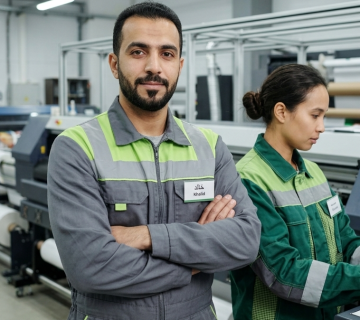
Protective uniforms form the backbone of workplace safety in high-risk industries where employee wellbeing cannot be compromised.These garments are planned to provide safety against physical, chemical, and environmental risks, and they ensure utility. In all the regulated industries within the UAE, organisations are increasingly relying on specifically constructed uniforms to facilitate compliance standards and aid the efficiency of the workforce.
Protective Uniforms and Their Role in Modern Industrial Safety
The kinds of the hazards at a workplace are different and diverse according to the nature of the work being carried out; hence protective uniforms should be made with specificity and purpose. These are clothes that provide a protective barrier against hell fire, abrasion, cleanliness and mechanical hazards. They also encourage professionalism and discipline of operations in various industrial environments in addition to safety.
The UAE modern industries have turned towards incorporating safety solutions as opposed to simple work attire. Current uniforms are designed to provide the wearer with a combination of longevity, breathability and movement. This development is a mark of the increased realization that working equipment has a direct impact on the productivity and the normalcy of employees.
Protective Uniforms as a Strategic Investment for Businesses
Investing in protective uniforms does not appear to be a regulatory mandatory any longer. Companies consider them as one of its strategic resources that enable it to endure in the long run. Good quality clothes save on the rate of injuries, loss time and wages and enhance the morale of the work force.
Companies that work with a trusted protective clothing supplier in UAE will access the advice of an expert regarding the choice of proper materials and designs. These suppliers are aware of local safety standards and risk-related to the industry. They are not just involved in supply, but also in making sure uniforms are in line with the real world working conditions.
Understanding Different Types of Protective Workwear
Different industries require specialised protective solutions, and it is necessary to know what types of workwear can be used. All the categories are aimed at certain hazards at the workplace and comfort during the long-term use. The choice of the right type assists in compliance with the regulations, as well as operational effectiveness in the long-term perspective.
Key Types of Protective Workwear
- Body Protection : This involves coverall uniform, safety vests, and aprons that are used to protect workers against dust, sparks, and chemical exposures. High risk environments demand the use of flame-resistant and arc-rated clothing to minimize the risk of burns and electrical injuries.
- Head and Face Protection : Hard hats, bump caps, welding helmets, and face shields are used to guard against impact, falling objects, heat and eye injuries in risky working areas.
- Reflective Clothing : Workers should be provided with high-visibility clothing, using jackets, trousers, and vests made of reflective materials that increase the visibility of the workers in low-light areas or high-traffic ones, thereby minimizing the chance of accidents.
- Hand/ARM Protection : Cut, chemical, heat and cold resistant, specialised gloves are dextrous and safe.
- Foot Protection : Safety footwear has steel or composite toes, slip-resistant soles and metatarsal pads to cushion against impact and surface hazards.
- Respiratory Protection : Respirators and masks protect the workers against the inhalation of dust, fumes, vapours, and dangerous airborne particles.
- Specialised Protective Suits : Hazard specific suits These include chemical, hazmat and NBC suits, which are specifically designed to protect against extreme environments where the greatest isolation and protection are required.
These protective workwear categories ensure workers remain safe, mobile, and productive without restricting movement or performance.
How Safety uniforms Enhance Workforce Performance
Safety uniforms do not only cover employees against such hazards, but also enhance performance considering the conditions of work under adverse environments. Well structured uniforms minimize fatigue since they provide movement flexibility and control of temperature. Workers are better concentrated and more productive when they feel physically safe.
Uniforms are also used to create visual consistency in areas like construction, logistics and manufacturing throughout the Emirates. This visibility enhances oversight, responsibility and safety awareness on crowded sites. The uniforms thus are made to be the method of defense as well as the method of controlling the operation.
Selecting the Right Protective Clothing Supplier
Choosing a supplier is as important a decision as the uniform itself. A reliable Protective Clothing Supplier offers not only products; they give valuable information regarding compliance, risk assessment, and the performance of textile. Their knowledge makes sure that companies buy uniforms that match the actual operational problems.
Among the factors that should be looked at while assessing suppliers are product certification, ability to customize, and delivery reliability. Suppliers that know the local industries well can effectively recommend the right solutions. With this partnership approach, safety spending is worthwhile for the long run.
Design and Material Considerations in Protective Workwear
Material selection is a key factor in determining the effectiveness of safety clothing. The fabric should be able to endure repeated use without losing its protective qualities. Factors like breathability, level of resistance, and durability have to be balanced properly for the different work environments.
- Flame-resistant textiles for high-temperature applications
- Reinforced stitching for long-term wear in heavy-duty roles
- Moisture-control fabrics for comfort during extended shifts
These features contribute to the overall performance of a PPE uniform, ensuring protection without compromising usability.
Compliance and Safety Standards in the UAE Workplace
Workplace safety regulations, especially in the Middle East, demand for the provision of appropriate protective clothing by employers depending on the occupational risk. Compliance with these not only guarantees legal conformity but also demonstrates moral commitment to employees’ welfare. Work uniforms should carry the safety certifications that are acknowledged and applicable to the respective industries.
Trusted Safety coverall suppliers in UAE play an important role in meeting these standards. They ensure garments align with regulatory benchmarks and industry expectations. Compliance-ready uniforms protect both workers and organisations from unnecessary risk.
The Importance of Customisation in Protective workwear
Customisation is vital for ensuring that protective workwear performs well even in harsh conditions. Instead of using standard designs, specially made uniforms focus on meeting specific operational and employee requirements.
- Generic solutions usually cannot effectively address the practical needs of different job functions
- Custom-fit protective workwear allow for more comfort, better movement, and greater wearability over time
- Design modifications make it possible to fit various body shapes and working environments
Additional tailored custom features even contribute to safety and convenience in different industrial sectors.
- Reinforced panels give extra protection in areas most prone to impacts
- Well-thought-out reflective positioning enhances visibility in dark environments
- The type of fabric can be chosen in accordance with the level of hazard exposure
Such considerate design features not only improve safety but also demonstrate an employer’s dedication to employee health and safety and regulatory compliance.
Maintaining and Managing Protective Workwear
Proper maintenance extends the lifespan and effectiveness of safety apparel, including the worker coverall uniform used in demanding environments. Uniforms must be cleaned and stored according to manufacturer guidelines to preserve their protective properties. Poor maintenance practices can compromise safety performance and lead to higher replacement costs.
Organisations often implement uniform management systems to monitor usage, condition, and wear cycles. This ensures damaged or worn garments are replaced on time and safety standards remain consistent. Proactive management supports uninterrupted protection across the workforce.
Future Trends in Protective Workwear
The future of safety uniforms is in the sphere of innovation and intelligent design. Technologies in fabrics are engaging in lighter, stronger and more flexible materials. The trends are a reaction to the increased need for comfort as well as security.
The upcoming generation of workwear is influenced by digital tracking, sustainable fabrics and modular designs. Companies that embrace contemporary solutions are ahead of the curve of the regulatory expectations and operational performance. Innovation guarantees the safety apparel to be developed according to the needs of the industry.
Conclusion
Protective uniforms are one of the most critical points of safety, performance and responsibility. When carefully chosen and well managed, they protect employees and at the same time facilitate operations. In the case of organisations working in the Gulf Regions, a partnership with skilled suppliers and the investment into good working clothes can guarantee the safety and adherence in the long term. By focusing on safety, companies establish more secure workplaces and healthier teams.
The protective workwear are needed due to their protective properties and helping to adhere to the safety standards. They ensure the safety of the workers and they also ensure uniformity with regard to safety. Proper uniforms are also good in increasing productivity by enhancing comfort and confidence.
These uniforms provide full-body coverage for general industrial protection, while a PPE uniform integrates specific protective features based on hazard type. PPE garments are designed for higher-risk environments. The choice depends on job requirements and exposure levels.
Replacement depends on usage intensity, exposure conditions, and maintenance quality. A worker’s coverall uniform should be replaced when protective integrity is compromised. Regular inspections help determine appropriate replacement cycles.